"No coupon talk, just a clear route through the problem. The Cahuenga Pass notes matched what the technician found on site, especially around Universal City edge, conduit route, and hillside AC replacement. We had enough information to compare options because the photos and closeout notes matched what we saw at the house."
Curated local service brief
Mid-Wilshire water heater repair for apartments, closets, and shared access.
Water heater repair and replacement in Mid-Wilshire should account for closet access, shared shutoffs, parking, manager approval, venting, drain pans, and whether a leak affects another unit.
Dense buildings can turn a routine no-hot-water call into a scheduling and damage-control problem.
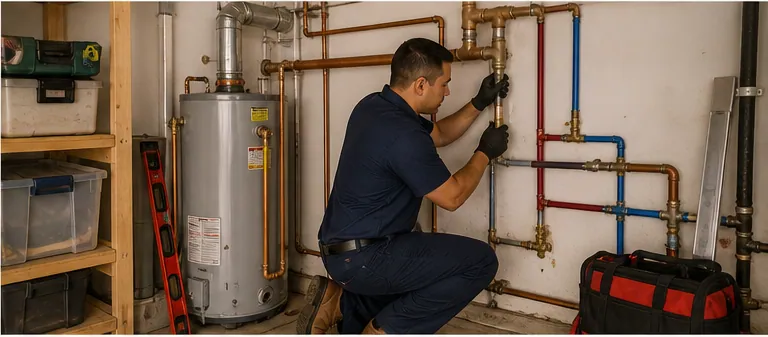
Fast answer
Water Heater Repair and Replacement in Mid-Wilshire: what decides the visit.
Route clueLa Brea corridor
Proof itemventing
Red flagActive tank leak
Local riskshared drains
LADWP and SoCalGas are common; multifamily buildings may require tenant, manager, and parking coordination. LADBS applies to many trade permits, with apartment access and inspection windows shaping schedule.
Mid-Wilshire intent
The first task is controlling water and proving whether the issue is tank failure, ignition, a valve, or building access.
The first task is controlling water and proving whether the issue is tank failure, ignition, a valve, or building access. This long-tail page exists because the owner is not asking for a generic trade menu; the real question is how water heater repair behaves inside older apartments, courtyard buildings, condos, duplexes, and commercial-adjacent spaces with roof ladders, shared shutoffs, parking restrictions, utility rooms, and occupied units.
Water heater repair and replacement in Mid-Wilshire should account for closet access, shared shutoffs, parking, manager approval, venting, drain pans, and whether a leak affects another unit. The field note should mention La Brea corridor, Museum Row, venting, and shared drains when those details are true at the address. Those specifics change the dispatch plan before any price range matters.
water heater repair sequence
The plumber should verify leak source, hot-water outage, shutoff function, venting, pan condition, and whether access requires manager or tenant coordination.
The plumber should verify leak source, hot-water outage, shutoff function, venting, pan condition, and whether access requires manager or tenant coordination. For Mid-Wilshire, the diagnostic sequence should be written in the order the technician will actually move through the property: arrival point, access path, affected equipment or fixture, support system, then the safe next step.
Water Heater Repair and Replacement can change direction when pan and drain route intersects with lighting and dedicated circuits. The estimate should call out that junction instead of hiding it inside a broad labor note.
La Brea corridor constraint
The first task is controlling water and proving whether the issue is tank failure, ignition, a valve, or building access.
LADWP and SoCalGas are common; multifamily buildings may require tenant, manager, and parking coordination. For this route, the utility note matters only after the field symptom is tied to the supporting system. That prevents a simple visit from turning into vague utility language without a repair reason.
LADBS applies to many trade permits, with apartment access and inspection windows shaping schedule. The permit assumption should be short and practical: diagnosis first, then a separate note if replacement, utility coordination, wall opening, or inspection timing becomes part of the scope.
dense apartment and museum corridor threshold
Repair is practical when the unit is newer and the failed component is external; replacement is cleaner when tank condition, venting, or leakage creates repeat risk.
Repair is practical when the unit is newer and the failed component is external; replacement is cleaner when tank condition, venting, or leakage creates repeat risk. The decision should be based on what the technician can prove at the address: symptom, age or condition, access, safety, and whether tank size makes a return visit likely.
urban heat, rooftop package-unit exposure, and aging building systems This local condition affects urgency and recurrence. It should appear in the closeout only when it connects to a real finding, such as shared drains or lighting and dedicated circuits.
Booking packet
Send tank label, full closet photo, shutoff photo, vent photo, building contact, parking instructions, and whether water is active now.
Send tank label, full closet photo, shutoff photo, vent photo, building contact, parking instructions, and whether water is active now. Add one wide photo and one close photo for each relevant area. A useful set shows the route, not only the broken device, so the visit can be staffed and sequenced correctly.
The closeout should say whether the unit is safe, what was repaired, what must be replaced, and what building approval or follow-up is needed. Keep that note with the property records. It helps the next owner, manager, inspector, or follow-up trade understand why the work was scoped the way it was.
Museum Row field memo
Mid-Wilshire notes that make this water heater repair page worth keeping.
La Brea corridor checkpoint: Send tank label, full closet photo, shutoff photo, vent photo, building contact, parking instructions, and whether water is active now. This is especially important in dense apartment and museum corridor properties where older apartments, courtyard buildings, condos, duplexes, and commercial-adjacent spaces can hide the actual service route. The first verification should connect venting with shared drains before anyone approves a broader scope.
Museum Row checkpoint: Repair is practical when the unit is newer and the failed component is external; replacement is cleaner when tank condition, venting, or leakage creates repeat risk. The owner should ask whether leaks, no hot water, pilot or ignition faults, rust, old tanks, code clearances, drain pans, venting, and garage or closet damage points to a contained repair, a safety stabilization, or a follow-up visit. The answer should mention pan and drain route, lighting and dedicated circuits, and the access condition that makes this address different.
water heater repair closeout
What should be written down after the Mid-Wilshire visit.
The closeout should say whether the unit is safe, what was repaired, what must be replaced, and what building approval or follow-up is needed. A useful note for this route also says what was not opened, what was not tested, and which symptom would justify a return visit. That keeps the page aligned with real homeowner decisions instead of search-only copy.
Dense buildings can turn a routine no-hot-water call into a scheduling and damage-control problem. If the estimate changes after diagnosis, the reason should be tied to tank size, gas smell, or lighting and dedicated circuits. Without that explanation, the owner cannot compare repair, replacement, or deferred work intelligently.
Mid-Wilshire field notes
Neighborhood-level cues for this long-tail visit.
Museum Row field note: The first task is controlling water and proving whether the issue is tank failure, ignition, a valve, or building access. This matters when seismic strapping is visible at the same time as lighting and dedicated circuits. The appointment should treat "Gas smell" as the clue that decides the first test, not as a generic label.
Museum Row owner prep: photograph the route connected to seismic strapping, then add a short note about lighting and dedicated circuits. For water heater repair, that local combination helps the technician decide whether the first visit should prioritize diagnosis, stabilization, replacement planning, or permit-aware follow-up.
Miracle Mile edge field note: The plumber should verify leak source, hot-water outage, shutoff function, venting, pan condition, and whether access requires manager or tenant coordination. This matters when pan and drain route is visible at the same time as roof-unit AC. The appointment should treat "No hot water for occupied unit" as the clue that decides the first test, not as a generic label.
Miracle Mile edge owner prep: photograph the route connected to pan and drain route, then add a short note about roof-unit AC. For water heater repair, that local combination helps the technician decide whether the first visit should prioritize diagnosis, stabilization, replacement planning, or permit-aware follow-up.
Wilshire Vista edge field note: The first task is controlling water and proving whether the issue is tank failure, ignition, a valve, or building access. This matters when code clearances is visible at the same time as shared drains. The appointment should treat "Active tank leak" as the clue that decides the first test, not as a generic label.
Wilshire Vista edge owner prep: photograph the route connected to code clearances, then add a short note about shared drains. For water heater repair, that local combination helps the technician decide whether the first visit should prioritize diagnosis, stabilization, replacement planning, or permit-aware follow-up.
La Brea corridor field note: Repair is practical when the unit is newer and the failed component is external; replacement is cleaner when tank condition, venting, or leakage creates repeat risk. This matters when tank size is visible at the same time as panel limitations. The appointment should treat "Water in drain pan" as the clue that decides the first test, not as a generic label.
La Brea corridor owner prep: photograph the route connected to tank size, then add a short note about panel limitations. For water heater repair, that local combination helps the technician decide whether the first visit should prioritize diagnosis, stabilization, replacement planning, or permit-aware follow-up.
Local risk proof
City-specific risks that change the estimate.
roof-unit AC verification in Miracle Mile edge: LADWP and SoCalGas are common; multifamily buildings may require tenant, manager, and parking coordination. For this route, the utility note matters only after the field symptom is tied to the supporting system. That prevents a simple visit from turning into vague utility language without a repair reason. The written scope should connect that finding to tank size and "No hot water for occupied unit" so the owner can see why this Mid-Wilshire page is not interchangeable with another water heater repair page.
shared drains verification in Wilshire Vista edge: urban heat, rooftop package-unit exposure, and aging building systems This local condition affects urgency and recurrence. It should appear in the closeout only when it connects to a real finding, such as shared drains or lighting and dedicated circuits. The written scope should connect that finding to venting and "Active tank leak" so the owner can see why this Mid-Wilshire page is not interchangeable with another water heater repair page.
panel limitations verification in La Brea corridor: Send tank label, full closet photo, shutoff photo, vent photo, building contact, parking instructions, and whether water is active now. Add one wide photo and one close photo for each relevant area. A useful set shows the route, not only the broken device, so the visit can be staffed and sequenced correctly. The written scope should connect that finding to seismic strapping and "Water in drain pan" so the owner can see why this Mid-Wilshire page is not interchangeable with another water heater repair page.
water heater closets verification in Museum Row: Museum Row checkpoint: Repair is practical when the unit is newer and the failed component is external; replacement is cleaner when tank condition, venting, or leakage creates repeat risk. The owner should ask whether leaks, no hot water, pilot or ignition faults, rust, old tanks, code clearances, drain pans, venting, and garage or closet damage points to a contained repair, a safety stabilization, or a follow-up visit. The answer should mention pan and drain route, lighting and dedicated circuits, and the access condition that makes this address different. The written scope should connect that finding to pan and drain route and "Gas smell" so the owner can see why this Mid-Wilshire page is not interchangeable with another water heater repair page.
lighting and dedicated circuits verification in Miracle Mile edge: The closeout should say whether the unit is safe, what was repaired, what must be replaced, and what building approval or follow-up is needed. A useful note for this route also says what was not opened, what was not tested, and which symptom would justify a return visit. That keeps the page aligned with real homeowner decisions instead of search-only copy. The written scope should connect that finding to code clearances and "No hot water for occupied unit" so the owner can see why this Mid-Wilshire page is not interchangeable with another water heater repair page.
Appointment prep
What the owner should have ready.
- Send tank label, full closet photo, shutoff photo, vent photo, building contact, parking instructions, and whether water is active now.
- The closeout should say whether the unit is safe, what was repaired, what must be replaced, and what building approval or follow-up is needed.
- Mention La Brea corridor or Museum Row if those cues describe the actual approach to the property.
- Ask whether venting, pan and drain route, or tank size is the first cost driver to verify.
- Treat water in drain pan as a priority signal, not a normal scheduling note.
Internal links
Route links for the next decision.
Book water heater repair in Mid-Wilshire.
Dense buildings can turn a routine no-hot-water call into a scheduling and damage-control problem.
FAQ
Questions homeowners ask before booking
What should I send before booking water heater repair in Mid-Wilshire?
Send tank label, full closet photo, shutoff photo, vent photo, building contact, parking instructions, and whether water is active now. The closeout should say whether the unit is safe, what was repaired, what must be replaced, and what building approval or follow-up is needed. Mention La Brea corridor or Museum Row if those cues describe the actual approach to the property. Add photos that show the actual access route, not only the failed equipment.
What usually changes the scope for this Mid-Wilshire visit?
The plumber should verify leak source, hot-water outage, shutoff function, venting, pan condition, and whether access requires manager or tenant coordination. For Mid-Wilshire, the diagnostic sequence should be written in the order the technician will actually move through the property: arrival point, access path, affected equipment or fixture, support system, then the safe next step.
When should this water heater repair request become urgent?
Repair is practical when the unit is newer and the failed component is external; replacement is cleaner when tank condition, venting, or leakage creates repeat risk. The decision should be based on what the technician can prove at the address: symptom, age or condition, access, safety, and whether tank size makes a return visit likely.
Customer reviews
Verified homeowner reviews from Los Angeles HVAC, electrical, and plumbing visits.
"The team treated our service request like a building problem, not only a part problem. For leak detection, they checked how repair method connected to the rest of the system and whether ADU utility sequencing would create a return visit near Sunset Junction. The closeout was strong because the estimate separated immediate stabilization from the follow-up scope."
"The written scope named the symptom, access issue, and condition that would change pricing. That was useful for our Fairfax house because furnace repair depended on venting route, and AC replacement access could not be ignored. After the visit, the notes gave our property manager enough detail to approve the next step."
"The EV charger installation visit in Topanga stayed practical from the first call. We mentioned the Fernwood access issue, and the technician checked wire length before pricing bigger work. Because PSPS readiness was documented with photos, the technician explained what was safe to use and what needed to stay off."
"Our north Valley residential district near Knollwood had more access issues than expected, but the water heater repair scope stayed clear. The technician explained how pan and drain route affected the labor and why undersized returns had to be checked before we approved anything. In the end, the written scope made the repair-versus-replace decision much easier."
"The technician started with the route, shutoff, and equipment location instead of jumping straight to a menu price. For emergency plumbing in Nichols Canyon, that mattered because damage location and AC equipment placement could have changed the scope. The best part was that the visit avoided a second trip because the access issue was handled early."
Mid-Wilshire reference set
Sources checked for this water heater repair brief.
Water heater repair and replacement in Mid-Wilshire should account for closet access, shared shutoffs, parking, manager approval, venting, drain pans, and whether a leak affects another unit.