"The written scope named the symptom, access issue, and condition that would change pricing. That was useful for our Hidden Hills house because emergency HVAC depended on roof or attic access, and whole-home load calculations could not be ignored. After the visit, the notes gave our property manager enough detail to approve the next step."
Curated local service brief
Cahuenga Pass emergency HVAC for canyon access and urgent cooling loss.
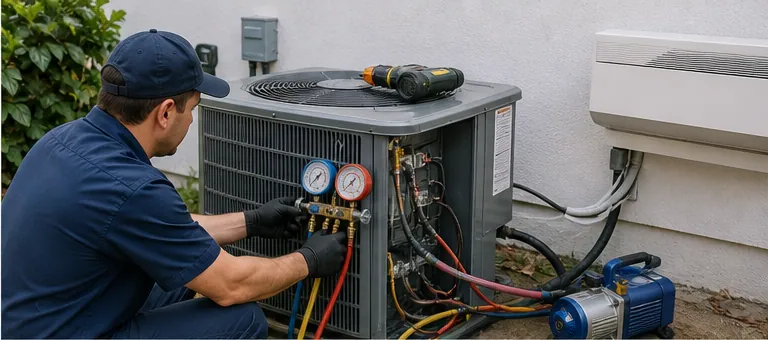
Emergency HVAC in Cahuenga Pass should focus on safe stabilization when cooling fails, electrical odor appears, airflow collapses, or access makes ordinary scheduling unrealistic.
Canyon roads, narrow drives, hillside equipment, and roof or attic access can change how quickly a technician can diagnose the system.
Fast answer
Emergency HVAC in Cahuenga Pass: what decides the visit.
Route clueHollywood Bowl edge
Proof itemsystem age
Red flagNo cooling with vulnerable occupants
Local riskgas shutoff access
LADWP service is common for city addresses; utility outages, steep routes, and tight staging need confirmation. LADBS permits and inspections are common, while hillside access can affect equipment replacement plans.
Cahuenga Pass intent
An urgent no-cool call is not always an equipment replacement; it may be airflow, power, condensate, control, or a safety shutoff.
An urgent no-cool call is not always an equipment replacement; it may be airflow, power, condensate, control, or a safety shutoff. This long-tail page exists because the owner is not asking for a generic trade menu; the real question is how emergency HVAC behaves inside hillside homes, apartments, small lots, older bungalows, and canyon-edge properties with steep streets, limited parking, stacked equipment, narrow stairs, and difficult condenser pads.
Emergency HVAC in Cahuenga Pass should focus on safe stabilization when cooling fails, electrical odor appears, airflow collapses, or access makes ordinary scheduling unrealistic. The field note should mention Hollywood Bowl edge, Cahuenga Pass, system age, and gas shutoff access when those details are true at the address. Those specifics change the dispatch plan before any price range matters.
emergency HVAC sequence
The technician should determine whether the indoor blower runs, whether the outdoor unit starts, whether ice or water is present, and whether electrical smell or breaker behavior makes the system unsafe.
The technician should determine whether the indoor blower runs, whether the outdoor unit starts, whether ice or water is present, and whether electrical smell or breaker behavior makes the system unsafe. For Cahuenga Pass, the diagnostic sequence should be written in the order the technician will actually move through the property: arrival point, access path, affected equipment or fixture, support system, then the safe next step.
Emergency HVAC can change direction when part availability intersects with water pressure issues. The estimate should call out that junction instead of hiding it inside a broad labor note.
Hollywood Bowl edge constraint
An urgent no-cool call is not always an equipment replacement; it may be airflow, power, condensate, control, or a safety shutoff.
LADWP service is common for city addresses; utility outages, steep routes, and tight staging need confirmation. For this route, the utility note matters only after the field symptom is tied to the supporting system. That prevents a simple visit from turning into vague utility language without a repair reason.
LADBS permits and inspections are common, while hillside access can affect equipment replacement plans. The permit assumption should be short and practical: diagnosis first, then a separate note if replacement, utility coordination, wall opening, or inspection timing becomes part of the scope.
hillside pass corridor threshold
Emergency work should restore safe operation when possible and clearly explain what permanent repair or replacement still remains.
Emergency work should restore safe operation when possible and clearly explain what permanent repair or replacement still remains. The decision should be based on what the technician can prove at the address: symptom, age or condition, access, safety, and whether safety shutoff needs makes a return visit likely.
sun exposure, canyon wind, dust, and noise-sensitive equipment placement This local condition affects urgency and recurrence. It should appear in the closeout only when it connects to a real finding, such as gas shutoff access or water pressure issues.
Booking packet
Owners should provide gate or parking notes, equipment photos, thermostat readings, filter condition, and the timeline of the failure.
Owners should provide gate or parking notes, equipment photos, thermostat readings, filter condition, and the timeline of the failure. Add one wide photo and one close photo for each relevant area. A useful set shows the route, not only the broken device, so the visit can be staffed and sequenced correctly.
The closeout should state what was stabilized, what must stay off, what part or access issue delayed completion, and whether a follow-up appointment is required. Keep that note with the property records. It helps the next owner, manager, inspector, or follow-up trade understand why the work was scoped the way it was.
Cahuenga Pass field memo
Cahuenga Pass notes that make this emergency HVAC page worth keeping.
Hollywood Bowl edge checkpoint: Owners should provide gate or parking notes, equipment photos, thermostat readings, filter condition, and the timeline of the failure. This is especially important in hillside pass corridor properties where hillside homes, apartments, small lots, older bungalows, and canyon-edge properties can hide the actual service route. The first verification should connect system age with gas shutoff access before anyone approves a broader scope.
Cahuenga Pass checkpoint: Emergency work should restore safe operation when possible and clearly explain what permanent repair or replacement still remains. The owner should ask whether after-hours no cooling, unsafe heat, burning smells, refrigerant concerns, smoke events, and urgent airflow failures points to a contained repair, a safety stabilization, or a follow-up visit. The answer should mention part availability, water pressure issues, and the access condition that makes this address different.
emergency HVAC closeout
What should be written down after the Cahuenga Pass visit.
The closeout should state what was stabilized, what must stay off, what part or access issue delayed completion, and whether a follow-up appointment is required. A useful note for this route also says what was not opened, what was not tested, and which symptom would justify a return visit. That keeps the page aligned with real homeowner decisions instead of search-only copy.
Canyon roads, narrow drives, hillside equipment, and roof or attic access can change how quickly a technician can diagnose the system. If the estimate changes after diagnosis, the reason should be tied to safety shutoff needs, ice on coil with airflow failure, or water pressure issues. Without that explanation, the owner cannot compare repair, replacement, or deferred work intelligently.
Cahuenga Pass field notes
Neighborhood-level cues for this long-tail visit.
Cahuenga Pass field note: An urgent no-cool call is not always an equipment replacement; it may be airflow, power, condensate, control, or a safety shutoff. This matters when system age is visible at the same time as breaker trips under load. The appointment should treat "Ice on coil with airflow failure" as the clue that decides the first test, not as a generic label.
Cahuenga Pass owner prep: photograph the route connected to system age, then add a short note about breaker trips under load. For emergency HVAC, that local combination helps the technician decide whether the first visit should prioritize diagnosis, stabilization, replacement planning, or permit-aware follow-up.
Universal City edge field note: The technician should determine whether the indoor blower runs, whether the outdoor unit starts, whether ice or water is present, and whether electrical smell or breaker behavior makes the system unsafe. This matters when after-hours timing is visible at the same time as water pressure issues. The appointment should treat "Furnace safety concern" as the clue that decides the first test, not as a generic label.
Universal City edge owner prep: photograph the route connected to after-hours timing, then add a short note about water pressure issues. For emergency HVAC, that local combination helps the technician decide whether the first visit should prioritize diagnosis, stabilization, replacement planning, or permit-aware follow-up.
Mulholland approach field note: An urgent no-cool call is not always an equipment replacement; it may be airflow, power, condensate, control, or a safety shutoff. This matters when part availability is visible at the same time as sewer slope. The appointment should treat "No cooling with vulnerable occupants" as the clue that decides the first test, not as a generic label.
Mulholland approach owner prep: photograph the route connected to part availability, then add a short note about sewer slope. For emergency HVAC, that local combination helps the technician decide whether the first visit should prioritize diagnosis, stabilization, replacement planning, or permit-aware follow-up.
Hollywood Bowl edge field note: Emergency work should restore safe operation when possible and clearly explain what permanent repair or replacement still remains. This matters when roof or attic access is visible at the same time as gas shutoff access. The appointment should treat "Electrical burning smell" as the clue that decides the first test, not as a generic label.
Hollywood Bowl edge owner prep: photograph the route connected to roof or attic access, then add a short note about gas shutoff access. For emergency HVAC, that local combination helps the technician decide whether the first visit should prioritize diagnosis, stabilization, replacement planning, or permit-aware follow-up.
Local risk proof
City-specific risks that change the estimate.
hillside AC replacement verification in Universal City edge: LADWP service is common for city addresses; utility outages, steep routes, and tight staging need confirmation. For this route, the utility note matters only after the field symptom is tied to the supporting system. That prevents a simple visit from turning into vague utility language without a repair reason. The written scope should connect that finding to roof or attic access and "Furnace safety concern" so the owner can see why this Cahuenga Pass page is not interchangeable with another emergency HVAC page.
breaker trips under load verification in Mulholland approach: sun exposure, canyon wind, dust, and noise-sensitive equipment placement This local condition affects urgency and recurrence. It should appear in the closeout only when it connects to a real finding, such as gas shutoff access or water pressure issues. The written scope should connect that finding to safety shutoff needs and "No cooling with vulnerable occupants" so the owner can see why this Cahuenga Pass page is not interchangeable with another emergency HVAC page.
water pressure issues verification in Hollywood Bowl edge: Owners should provide gate or parking notes, equipment photos, thermostat readings, filter condition, and the timeline of the failure. Add one wide photo and one close photo for each relevant area. A useful set shows the route, not only the broken device, so the visit can be staffed and sequenced correctly. The written scope should connect that finding to system age and "Electrical burning smell" so the owner can see why this Cahuenga Pass page is not interchangeable with another emergency HVAC page.
sewer slope verification in Cahuenga Pass: Cahuenga Pass checkpoint: Emergency work should restore safe operation when possible and clearly explain what permanent repair or replacement still remains. The owner should ask whether after-hours no cooling, unsafe heat, burning smells, refrigerant concerns, smoke events, and urgent airflow failures points to a contained repair, a safety stabilization, or a follow-up visit. The answer should mention part availability, water pressure issues, and the access condition that makes this address different. The written scope should connect that finding to after-hours timing and "Ice on coil with airflow failure" so the owner can see why this Cahuenga Pass page is not interchangeable with another emergency HVAC page.
gas shutoff access verification in Universal City edge: The closeout should state what was stabilized, what must stay off, what part or access issue delayed completion, and whether a follow-up appointment is required. A useful note for this route also says what was not opened, what was not tested, and which symptom would justify a return visit. That keeps the page aligned with real homeowner decisions instead of search-only copy. The written scope should connect that finding to part availability and "Furnace safety concern" so the owner can see why this Cahuenga Pass page is not interchangeable with another emergency HVAC page.
Appointment prep
What the owner should have ready.
- Owners should provide gate or parking notes, equipment photos, thermostat readings, filter condition, and the timeline of the failure.
- The closeout should state what was stabilized, what must stay off, what part or access issue delayed completion, and whether a follow-up appointment is required.
- Mention Hollywood Bowl edge or Cahuenga Pass if those cues describe the actual approach to the property.
- Ask whether system age, part availability, or safety shutoff needs is the first cost driver to verify.
- Treat electrical burning smell as a priority signal, not a normal scheduling note.
Internal links
Route links for the next decision.
Book emergency HVAC in Cahuenga Pass.
Canyon roads, narrow drives, hillside equipment, and roof or attic access can change how quickly a technician can diagnose the system.
FAQ
Questions homeowners ask before booking
What should I send before booking emergency HVAC in Cahuenga Pass?
Owners should provide gate or parking notes, equipment photos, thermostat readings, filter condition, and the timeline of the failure. The closeout should state what was stabilized, what must stay off, what part or access issue delayed completion, and whether a follow-up appointment is required. Mention Hollywood Bowl edge or Cahuenga Pass if those cues describe the actual approach to the property. Add photos that show the actual access route, not only the failed equipment.
What usually changes the scope for this Cahuenga Pass visit?
The technician should determine whether the indoor blower runs, whether the outdoor unit starts, whether ice or water is present, and whether electrical smell or breaker behavior makes the system unsafe. For Cahuenga Pass, the diagnostic sequence should be written in the order the technician will actually move through the property: arrival point, access path, affected equipment or fixture, support system, then the safe next step.
When should this emergency HVAC request become urgent?
Emergency work should restore safe operation when possible and clearly explain what permanent repair or replacement still remains. The decision should be based on what the technician can prove at the address: symptom, age or condition, access, safety, and whether safety shutoff needs makes a return visit likely.
Customer reviews
Verified homeowner reviews from Los Angeles HVAC, electrical, and plumbing visits.
"The generator backup readiness visit in Sherman Oaks stayed practical from the first call. We mentioned the Sherman Oaks Hills access issue, and the technician checked critical circuit count before pricing bigger work. Because condo HVAC replacement was documented with photos, the technician explained what was safe to use and what needed to stay off."
"Our hillside reservoir neighborhood near Wonder View had more access issues than expected, but the repiping scope stayed clear. The technician explained how fixture count affected the labor and why heat pump placement had to be checked before we approved anything. In the end, the written scope made the repair-versus-replace decision much easier."
"The technician started with the route, shutoff, and equipment location instead of jumping straight to a menu price. For ductless mini-split installation in Hancock Park, that mattered because line-hide route and duct redesign could have changed the scope. The best part was that the visit avoided a second trip because the access issue was handled early."
"For a Westchester property around Manchester corridor, the visit felt organized and specific. The repair option, replacement trigger, and wall finish access issue were all written down. We also appreciated that filter loading was treated as a real field condition, not a generic warning, so the photos and closeout notes matched what we saw at the house."
"We sent photos before the appointment, and it helped. The tankless water heater installation visit focused on condensate drain, the Topanga corridor access route, and the local concern around AC no-cool calls instead of guessing from the service label alone. That made the final recommendation useful because the estimate separated immediate stabilization from the follow-up scope."
Cahuenga Pass reference set
Sources checked for this emergency HVAC brief.
Emergency HVAC in Cahuenga Pass should focus on safe stabilization when cooling fails, electrical odor appears, airflow collapses, or access makes ordinary scheduling unrealistic.